
Wall pilates has been everywhere — TikTok, YouTube, Instagram Reels. Challenges with millions of views. Before-and-after posts that look almost too good. And a simple promise: all you need is a wall and 15 minutes a day.
If you’re wondering whether wall pilates actually delivers, or if it’s just another social media fitness trend that fades by next quarter, you’re asking the right question. The short answer: yes, it works — but not for everything, and probably not in the way most viral videos suggest.
This guide covers what wall pilates actually is, what it can and can’t do for your body, the specific exercises worth learning, what the research says, who benefits most, and where the method has real limitations. No hype, no app to sell, just an honest breakdown.
Table of Contents
What Wall Pilates Actually Is
Wall pilates takes traditional Pilates movements and modifies them using a wall for support, resistance, and alignment feedback. You press your hands, feet, back, or side against the wall while performing squats, bridges, planks, and leg raises. The wall creates isometric resistance — you’re pushing against a surface that doesn’t move, which forces your muscles to work harder than they would against gravity alone.
The concept isn’t new, despite what social media suggests. Joseph Pilates himself used wall exercises in his original practice. He had students hold squats against the wall to build leg and core strength simultaneously, and used wall-supported positions to prepare clients for activities like skiing. The current trend is really a return to something the method’s creator already knew worked.
What makes wall pilates genuinely useful is the wall’s dual function: it makes some exercises easier (by providing balance support) and others harder (by creating resistance you can push against). A wall bridge with feet elevated changes the angle of gravity on your glutes and hamstrings in ways that a floor bridge simply can’t match. A wall sit creates sustained isometric tension in your quads that floor-based Pilates doesn’t offer. That versatility is what gives the method staying power beyond the viral moment.
What Wall Pilates Does Well (and What It Doesn’t)
Before spending six weeks on any fitness routine, you deserve to know exactly what you’re signing up for. Here’s an honest goal-by-goal assessment.
Core Strength: Yes, It Works
This is wall pilates’ strongest suit, and the research backing is solid. A 2023 systematic review in the Journal of Clinical Medicine analyzed 27 studies on Pilates and core activation. The conclusion: Pilates significantly improves deep core muscle activation — specifically the transverse abdominis and multifidus, the deep spinal stabilizers that act like a corset around your midsection.
Wall pilates trains these muscles to fire automatically. When they strengthen, they pull your waist inward, improving how your midsection looks without any fat loss at all. This is why people often notice a visible change in their torso shape within weeks, even though the scale hasn’t budged.
Posture: Yes, Extremely Well
A 2021 study in the Journal of Bodywork and Movement Therapies found that 8 weeks of Pilates practice (three sessions per week) produced significant improvements in forward head posture, rounded shoulders, and pelvic tilt — the three postural problems that make you look heavier and shorter than you are.
Wall pilates has a specific advantage here that mat Pilates doesn’t. When your back is against a wall, you can feel exactly where your spine deviates from neutral. You can feel your lower back arching, your ribs flaring, your shoulders rounding. That tactile feedback accelerates postural correction because you’re not guessing — you know.
Flexibility: Yes
A 2020 systematic review in BMC Musculoskeletal Disorders confirmed that Pilates improves hamstring flexibility, hip flexor length, and spinal mobility. Wall pilates enhances this further because gravity assists the stretch: when your legs are elevated against the wall, gravity deepens hamstring and hip flexor stretches beyond what you could achieve lying flat.
Weight Loss: Partially (The Honest Part)
Here’s where the viral content misleads people. A 15-minute wall pilates session burns roughly 80 to 120 calories, depending on your body weight and intensity. That’s meaningful for muscle building and toning, but it’s not enough to create a significant caloric deficit on its own.
A 2021 meta-analysis published in Frontiers in Physiology found that Pilates programs can reduce body weight, BMI, and body fat percentage — but this happened in longer-duration interventions and was driven more by muscle-building and metabolic improvements than by the direct calorie burn of the sessions.
If your goal is losing 5 or 10 kilograms, wall pilates alone won’t get you there. What it will do: reshape how your body looks (better posture, tighter core, more defined muscles), improve how it functions, and support fat loss when combined with nutritional changes. The Pilates handles body composition and shape; nutrition handles the weight loss. Expecting wall pilates to do both leads to disappointment.
Also worth stating clearly: spot reduction doesn’t exist. No wall pilates exercise will specifically burn belly fat. Fat loss happens across the body, driven by caloric deficit, and influenced by genetics and hormones that determine where you lose it first.
Sleep and Stress: Yes, Measurably
Research shows that Pilates reduces Pittsburgh Sleep Quality Index (PSQI) scores by an average of -3.60. The controlled breathing patterns activate the parasympathetic nervous system — the branch responsible for relaxation and recovery. Wall pilates sessions done in the evening, particularly legs-up-the-wall positions, have a tangible calming effect that translates to better sleep onset and quality.
How Wall Pilates Differs from Mat and Reformer Pilates
If you’re coming from a Pilates background (or considering multiple forms), understanding where wall Pilates sits relative to the other main options helps you decide what fits your goals.
Wall Pilates vs Mat Pilates
The resistance mechanism is the main difference. In mat Pilates, gravity and body weight provide all the resistance. In wall Pilates, you’re pushing against an immovable surface — isometric resistance that forces muscle engagement at varying levels of your maximal effort.
The wall also provides alignment feedback that a mat doesn’t. During a side-lying leg raise on a mat, you have no external reference for whether your hips are stacked correctly. Slide your heel up the wall during the same exercise and the wall tells you instantly.
Mat Pilates does have one edge: a deeper core challenge. Without the wall to stabilize you, your core has to do all the stabilization work itself. That’s harder, and for experienced practitioners, it produces a more demanding core workout. Wall pilates is better for beginners who need support; mat Pilates is better for those who’ve already built body awareness and want to increase the challenge.
Wall Pilates vs Reformer Pilates
The reformer is a different category entirely. It uses springs for adjustable resistance, straps for arm and leg work, and a sliding carriage that creates an unstable surface. The result: more exercise variety, more upper-body challenge, and the ability to scale resistance precisely.
Wall Pilates can’t fully replicate what a reformer offers — particularly for upper body strength and progressive overload. But here’s the thing: a decent reformer costs $3,000 to $6,000. A wall costs nothing. Reformer classes run $25 to $85 per session. Wall pilates is free.
The comparison that matters: wall pilates mimics some of what a reformer does (particularly the foot-bar resistance during bridges) at zero cost and zero equipment. It won’t match a reformer for total exercise variety, but for core strength, posture correction, and lower body toning, it delivers legitimate results in a living room.
8 Wall Pilates Exercises Worth Learning
These exercises are ordered from most accessible to most challenging. Start with the first four. Add the rest as your strength and confidence build.
1. Wall Roll-Down
Stand with your back flat against the wall, feet about six inches from the base. Tuck your chin to your chest and slowly peel each vertebra away from the wall, one at a time, letting your arms hang toward the floor. When you’ve folded as far as comfortable, reverse the motion — rebuild your spine against the wall from the tailbone up. Repeat 5 to 8 times.
This is the single best exercise for spinal mobility and postural awareness. The wall gives you direct feedback on how your spine articulates, vertebra by vertebra. Most people discover their mid-back barely moves — that’s exactly the area this exercise targets.
2. Wall Sit
Stand with your back against the wall and walk your feet forward about a foot while sliding into a squat. Your knees and hips should both bend near 90 degrees, back pressed flat. Hold for 20 to 60 seconds. Rest. Repeat 3 times.
Progression: add calf raises while holding the sit. Lift your heels, hold 5 seconds, lower. Complete 10 calf raises per hold.
The wall sit is deceptively brutal. It’s pure isometric work — your quads, glutes, and core are firing continuously with nowhere to hide. If 90 degrees feels impossible, start higher and work your way down over weeks.
3. Elevated Hip Bridge
Lie on your back about one foot from the wall. Plant your feet flat on the wall with knees bent at 90 degrees — legs in a tabletop position. Press your feet into the wall to activate hamstrings and glutes, then lift your hips until your body forms a straight line from shoulders to knees. Lower with control. Complete 2 to 3 sets of 10 to 16 reps.
This variation changes the angle of gravity compared to a floor bridge. The wall provides stable resistance that lets you load the glutes and hamstrings more deliberately. If you feel this mostly in your lower back, your hips are too close to (or too far from) the wall — adjust until the burn centers in your glutes.
4. Leg Raises Against the Wall
Stand facing the wall with both hands flat at shoulder height. Keep your spine neutral as you lift one leg straight back behind you, squeezing your glute at the top of each lift. Hold briefly, lower with control. Repeat for 60 seconds per side.
The wall removes the balance variable from this movement, which means you actually work your glutes instead of wobbling and compensating with your lower back. Beginners often find standing leg raises nearly impossible without support — the wall fixes that.
5. Wall Push-Up
Stand facing the wall, arms extended with palms flat at shoulder height. Bend your elbows and lower your chest toward the wall on a slow 4-count. Push back to start on another 4-count. Complete 2 to 3 sets of 10 to 15 reps.
This is wall pilates’ main upper body exercise. The angle is gentler than a floor push-up, making it accessible for beginners, but the slow tempo and controlled breathing turn it into a genuine chest and shoulder workout. Progression: step your feet further from the wall to increase the angle and load.
6. Wall Plank
Place your feet against the base of the wall behind you and hold a standard plank position with hands on the floor. The wall prevents your feet from sliding and creates a fixed anchor point. Hold 30 to 60 seconds. Rest. Repeat 3 times.
With your feet against the wall, you can push backward slightly into the wall’s resistance, which engages your core more aggressively than a regular plank. You’ll feel this in your deep abdominals, shoulders, and upper back.
7. Single-Leg Wall Bridge
Set up like a standard elevated bridge, but extend one leg straight toward the ceiling while pressing the other foot into the wall. Bridge up using only the working leg. Complete 8 to 12 reps per side.
This is where wall pilates starts demanding real strength. The single-leg version doubles the load on each glute and hamstring while challenging your pelvic stability. If your hips drop to one side, you’re not ready — go back to the two-leg version until you can bridge without any lateral shift.
8. Legs-Up-the-Wall (Viparita Karani)
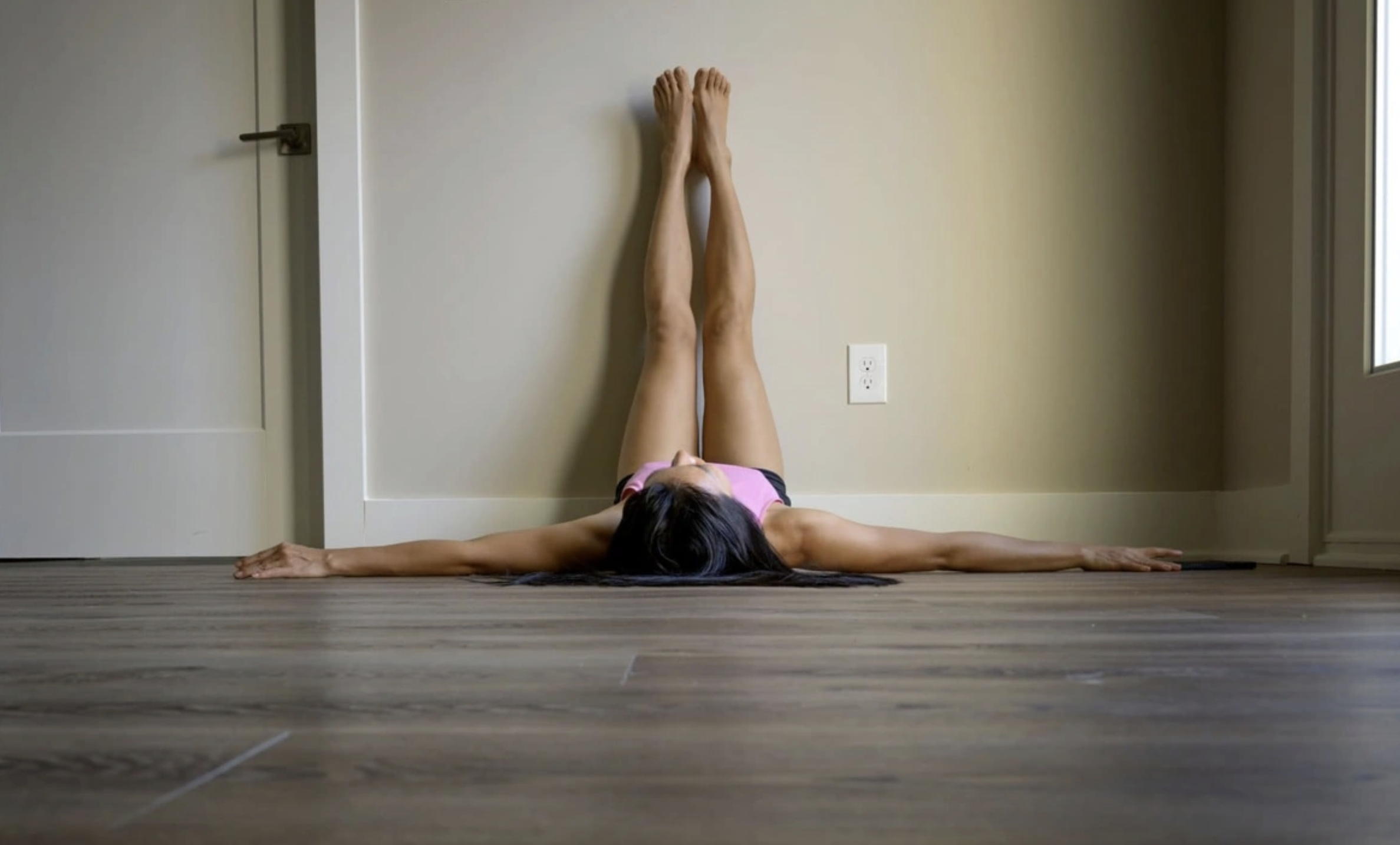
Sit sideways next to the wall, then swing your legs up so your back rests on the floor and your legs extend straight up the wall. Scoot your hips as close to the wall as comfortable. Stay for 5 to 15 minutes with controlled breathing.
This isn’t technically a strength exercise — it’s a recovery position. Elevating your legs 6 to 12 inches above heart level reduces venous pressure and helps drain fluid that accumulates from sitting or standing all day. It’s the wall pilates version of active recovery, and practitioners who use it consistently report lighter legs, reduced swelling, and better sleep when done in the evening.
Adding Resistance: How to Progress Beyond Body Weight
One common critique of wall pilates is that it can’t provide progressive overload — you can’t add weight to a wall. That’s true in the strictest sense, but there are practical ways to keep progressing.
Resistance bands: Loop a band around your thighs during wall bridges and wall sits to increase glute activation. Add a band around your wrists during wall push-ups for shoulder work.
Ankle weights: Light ankle weights (1 to 3 pounds) significantly increase the challenge during standing leg raises and single-leg bridges. Start light — ankle weights amplify load on joints, not just muscles.
Small Pilates ball: Place a small ball between your knees during wall sits and bridges for inner thigh engagement, or behind your lower back during wall roll-downs for spinal massage and deeper mobilization.
Tempo manipulation: The cheapest way to progress is to slow down. A wall sit held for 60 seconds is dramatically harder than one held for 20. A 6-count push-up is more demanding than a 4-count. Time under tension is the primary driver of muscle adaptation in wall pilates — use it.
The Mental Health Benefits (They’re Surprisingly Significant)
Physical results get all the attention, but the mental shifts that wall pilates produces are what keep people coming back long-term.
The controlled breathing patterns central to Pilates activate the parasympathetic nervous system — the branch responsible for calming you down. Where high-intensity workouts can spike cortisol (your stress hormone), wall pilates brings it down. That makes it a fundamentally different kind of exercise experience for people who are already running on stress.
Research has shown that regular Pilates practice reduces symptoms of depression and anxiety. The mechanism combines endorphin release from physical effort with the mindfulness inherent in slow, precise movement. When you’re counting a 4-count wall sit or tracking the alignment of your spine against the wall, there’s no mental bandwidth left for rumination or worry. It’s forced present-moment focus — meditation with a physical component.
Concentration improvements carry outside the session. Practitioners commonly report better focus at work, clearer thinking, and improved ability to manage emotional reactions after establishing a consistent practice. The discipline of slow, precise movement trains your brain to override the impulse toward distraction.
Who Gets the Most from Wall Pilates
Complete Beginners
If you’ve never done Pilates (or any structured exercise), wall pilates is arguably the best starting point. The wall provides stability, alignment feedback, and resistance scaling all at once. You get coached by a surface that won’t judge your form — but won’t let you cheat it either.
People with Desk Jobs
If you sit 8+ hours a day, wall pilates directly targets every problem that sitting creates: tight hip flexors, dormant glutes, rounded shoulders, compressed spine, and a disengaged core. The postural corrections alone make it worth 15 minutes a day.
Adults Over 50
Wall pilates is increasingly popular among adults over 50 for good reason. The wall support reduces fall risk during exercises that might otherwise challenge balance. The low-impact nature protects joints that years of running or high-impact sports may have stressed. And the core and balance improvements directly translate to fall prevention — one of the most critical fitness outcomes for aging adults.
For women in menopause, wall pilates addresses several common concerns. Core strengthening improves posture and reduces the appearance of “menopause belly” (which is often more postural than fat-related). The controlled breathing helps manage the stress and sleep disruption that hormonal changes create. While wall pilates won’t directly address hormonal changes, it supports the broader lifestyle approach — exercise, sleep, nutrition — that manages menopause symptoms most effectively.
People Recovering from Injury or Managing Pain
The wall provides spinal support during exercises, reducing load on painful areas. Wall pilates is used in rehabilitation settings for exactly this purpose. You build strength with minimal impact on compromised joints. If you have back pain, hip issues, or recovering from surgery, the wall lets you train around limitations rather than being stopped by them.
People on a Budget
This is wall pilates’ most underrated advantage. It costs nothing. No equipment, no membership, no app subscription required. A wall and 15 minutes is the entire setup. That removes every barrier — cost, space, travel time — that usually prevents people from maintaining a consistent exercise practice.
How to Structure Your Wall Pilates Practice
Frequency matters more than duration. Three to four sessions per week of 15 to 20 minutes produces better results than one 60-minute session weekly. Consistency drives adaptation; sporadic effort doesn’t.
A practical weekly structure:
Sessions 1 and 3: Lower body focus — wall sits, elevated bridges, single-leg bridges, standing leg raises. Finish with legs-up-the-wall for 5 minutes.
Sessions 2 and 4: Core and upper body focus — wall roll-downs, wall planks, wall push-ups, wall-supported side planks. Finish with controlled breathing in a seated wall-supported position.
Start with 10 to 15 minutes per session if you’re a true beginner. Build to 20 to 25 minutes over the first month as your endurance improves.
Results Timeline
Week 1 to 2: You’ll feel different — better body awareness, reduced muscle tension, improved breathing patterns. Nothing visible yet.
Week 3 to 4: Posture improvements become noticeable. You’ll stand taller, sit straighter, and feel your core engaging during daily activities.
Week 4 to 6: Strength gains emerge. Exercises that felt difficult in week one become manageable. Core definition starts to appear.
Week 6 to 12: Visible toning. Muscle definition, a flatter midsection from deep core strengthening, better overall body composition. This is when other people start noticing.
Strength gains specifically show up at the 4 to 6 week mark as your nervous system improves muscle activation efficiency. Actual muscle size changes take roughly 12 weeks of consistent training.
The 28-Day Wall Pilates Challenge: Is It Worth It?
The 28-day wall pilates challenge has become a cultural moment — the original YouTube challenge alone has drawn over four million views. App-based versions from companies like BetterMe and Wall Pilates have expanded the concept further.
Is a 28-day challenge a good way to start? Yes, with caveats. The structure removes decision fatigue. Having a new routine prescribed each day eliminates the “what should I do today” problem that kills consistency. And 28 days is enough time to feel real changes in core strength, posture, and body awareness.
The caveat: 28 days is not enough time for dramatic visible transformation. If someone’s before-and-after photos show a major change in one month, lighting, posture, and clothing are doing most of the work. Real body composition shifts take 8 to 12 weeks of consistent effort. A 28-day challenge is an on-ramp, not a destination.
Common Mistakes to Avoid
Holding your breath. Pilates is breath-driven movement. Inhale through your nose to prepare. Exhale through your mouth during the effort phase. Holding your breath during a wall sit or plank spikes blood pressure and reduces core activation.
Standing too close (or too far) from the wall. For bridges, roughly one foot away is a starting point. If you feel the work in your lower back instead of your glutes, adjust your distance. For wall sits, your shins should be roughly vertical — knees stacked over ankles, not pushed forward.
Rushing through exercises. Speed is the enemy of wall pilates. Slow down. A 4-count descent and 4-count ascent produces dramatically more muscle activation than fast reps. The slower you go, the harder it gets — that’s by design.
Expecting wall pilates to replace everything. Wall pilates excels at core, posture, lower body, and flexibility. It’s more limited for upper body strength (wall push-ups can only do so much) and cardiovascular conditioning. If you want comprehensive fitness, pair wall pilates with walking, light resistance training, or another form of cardio.
FAQs
Is Wall Pilates as Effective as Reformer Pilates?
For core strength, posture, and lower body toning, wall pilates produces comparable results. The reformer has advantages in upper body training, exercise variety, and progressive resistance scaling. But the reformer costs $3,000+ and classes run $25 to $85 per session. Wall pilates delivers 70 to 80% of the benefit at zero cost and zero equipment. For most home practitioners, that trade-off is excellent.
Can Wall Pilates Actually Help Me Lose Weight?
Wall pilates supports weight loss by building lean muscle (which raises your resting metabolism), improving body composition, and creating a consistent exercise habit. But a 15-minute session burns only 80 to 120 calories. For significant weight loss, you need to combine wall pilates with nutritional changes that create a caloric deficit. Wall pilates changes how your body looks and functions; nutrition changes what the scale says.
How Long Until I See Visible Results from Wall Pilates?
Posture improvements: 3 to 4 weeks. Core strength gains: 4 to 6 weeks. Visible muscle toning and body shape changes: 6 to 12 weeks. These timelines assume 3 to 4 sessions per week of 15 to 20 minutes each. Starting from zero exercise, you may notice strength and balance changes even sooner because the baseline improvement is steeper.
Is 15 Minutes of Wall Pilates Actually Enough?
Yes. Fifteen minutes of focused, controlled wall pilates three to four times a week produces measurable improvements in core strength, flexibility, and posture. Slow, precise movements with proper breathing activate more muscle fibers than 30 minutes of rushed work. Research has confirmed that short workout routines (even 13 minutes, three times weekly) provide meaningful strength and endurance benefits when performed consistently.
Is Wall Pilates Safe During Pregnancy?
Wall pilates can be practiced during pregnancy with modifications and medical clearance. The wall support helps with balance as your center of gravity shifts, and low-impact core work supports the postural changes pregnancy creates. Avoid deep abdominal exercises and exercises lying flat on your back after the first trimester. Work with a qualified instructor or use a prenatal-specific program, and always get clearance from your healthcare provider.
Can Older Adults Do Wall Pilates?
Wall pilates is one of the best exercise options for adults over 50. The wall provides stability that reduces fall risk, the exercises are low-impact and joint-friendly, and the balance and core improvements directly support fall prevention. Many practitioners start with just 10 minutes, three times a week, and build from there. If you have specific joint issues or chronic conditions, check with your doctor first, but for most adults, wall pilates is safe and effective.
